The Enigmatic Maya Blue: A Testament to Ancient Innovation
Introduction
Maya blue, a pigment revered for its vibrant hue and remarkable durability, stands among the most extraordinary technological achievements of ancient Mesoamerica. Used extensively in Maya art, architecture, and ritual objects, this distinctive pigment has survived centuries of exposure to tropical environments while retaining much of its original brilliance. Its enduring presence on murals, pottery, sculptures, and ceremonial offerings provides a remarkable window into the ingenuity, spirituality, and artistic sophistication of the ancient Maya.
Far more than a decorative color, Maya blue held profound religious significance. Associated with water, fertility, sacrifice, and divine power, it occupied a central role in Maya ceremonial life. Modern scientific research continues to reveal new dimensions of this remarkable material, demonstrating that Maya blue was not only a technological innovation but also part of a broader network of trade, ritual knowledge, and cultural exchange that connected distant regions of the Maya world.
This article delves into Maya blue’s historical, cultural, and scientific facets, exploring its broader context in pre-Columbian Mesoamerica while highlighting its specific applications to Maya artifacts.
Historical Context
The earliest known use of Maya blue dates to approximately 300 CE, and its popularity flourished during the Classic Period (250–900 CE). The pigment was applied to pottery, murals, sculptures, codices, and sacred offerings. Its use extended well beyond aesthetics, becoming deeply intertwined with religious ceremonies and royal authority.
While blue pigments were known among neighboring cultures such as the Aztecs and Mixtecs, the Maya developed a particularly strong symbolic and ritual association with the color. One of the most important archaeological discoveries involving Maya blue occurred in the Sacred Cenote at Chichen Itza, where archaeologists recovered artifacts and human remains coated with the pigment. These findings provided compelling evidence that Maya blue played a significant role in sacrificial rituals dedicated to deities associated with rain, fertility, and agricultural abundance.
Spanish chronicler Bishop Diego de Landa later recorded that sacrificial victims and altars were often painted blue, reinforcing the color’s sacred role within Maya religious practices.
Chemical Composition and Production
The brilliance and durability of Maya blue derive from its unusual composition. The pigment was created by combining indigo, an organic dye extracted from plants, with palygorskite, a fibrous clay mineral.
Unlike ordinary indigo, which gradually deteriorates when exposed to sunlight and environmental conditions, Maya blue exhibits exceptional resistance to weathering, acids, and humidity. This remarkable stability explains why the pigment remains visible on artifacts more than a thousand years after its creation.
Steps to Create Maya Blue:
1. Harvesting Indigo: Indigo dye was extracted from the leaves of plants such as Indigofera suffruticosa.
2. Acquiring Palygorskite: This clay was sourced from specific regions, including deposits in the Yucatán Peninsula.
3. Mixing and Heating: The indigo and clay were combined and heated to approximately 200–300°C, forming a durable hybrid material.
Recent research has also strengthened a long-standing theory regarding the pigment’s ritual creation. At Chichen Itza, archaeologists identified indigo, palygorskite, Maya blue, and melted copal incense together within an offering vessel. This evidence suggests that Maya blue may have been produced during ceremonial burning rituals involving copal incense, linking its manufacture directly to sacred activities rather than ordinary workshop production.
The process demonstrates an advanced understanding of materials and chemistry. By successfully bonding an organic dye with an inorganic mineral, Maya artisans created one of the most durable pigments ever produced in the ancient world.
Applications in Maya Artifacts
Maya blue adorned various mediums, each serving a distinct purpose in cultural and spiritual contexts:
1. Murals and Frescoes: The pigment was used to depict gods, rituals, and cosmological themes on temple walls, symbolizing divinity and the connection between the earthly and the divine.
2. Ceramics: Maya blue appeared on pottery used in everyday life and ceremonial contexts, such as burial offerings.
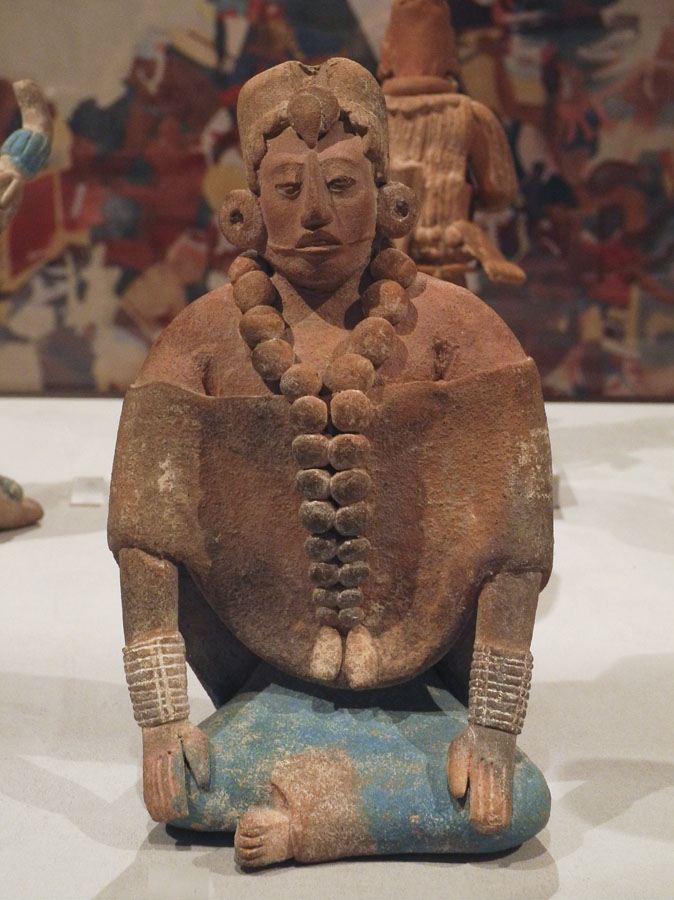
3. Sculptures and Figurines: Many artifacts feature intricate designs painted with Maya blue, emphasizing their importance in rituals.
4. Sacrificial Offerings: Objects coated in Maya blue were discovered in cenotes, where they were likely deposited as part of rain and fertility rituals.
Numerous objects recovered from cenotes and ceremonial deposits bear traces of Maya blue. These offerings were likely dedicated to supernatural forces associated with rain, fertility, and agricultural prosperity.
The continued visibility of the pigment on many of these objects underscores both its technical sophistication and its importance within Maya ceremonial life.
Sacred Meaning and the Cult of Chaac
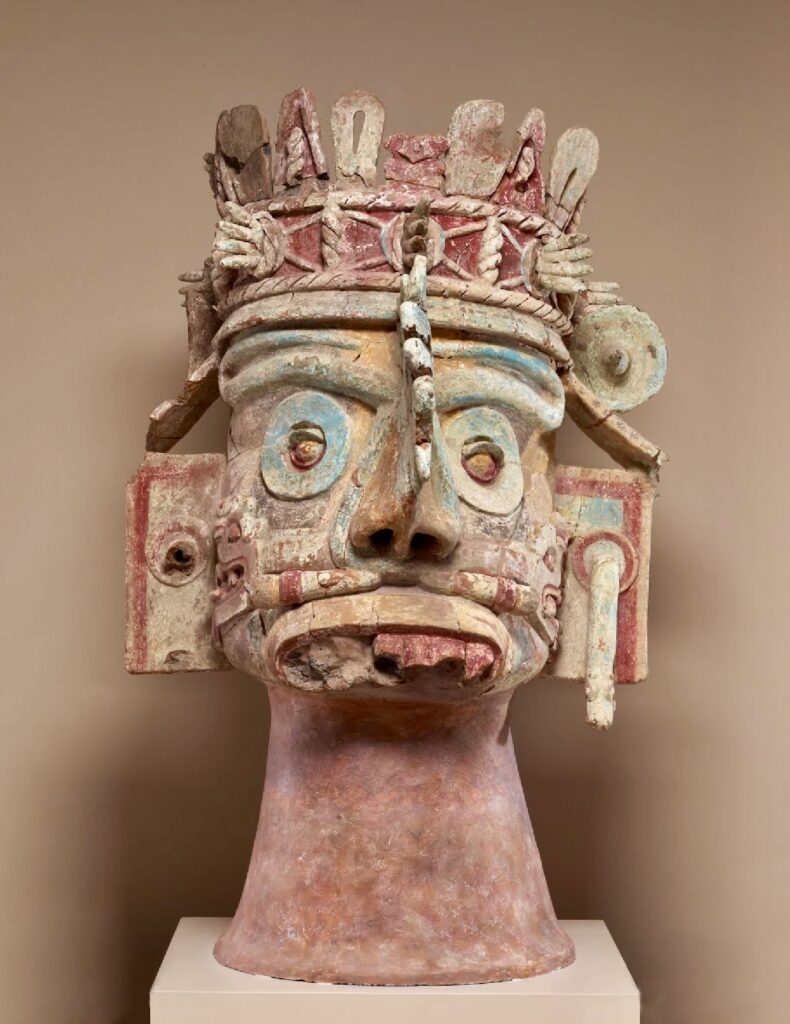
For the Maya, blue symbolized far more than color alone. It represented water, rain-filled skies, fertility, renewal, and communication with the divine realm. The pigment became especially associated with Chaac, the Maya rain god whose favor was essential for successful agriculture.
Recent research at Buenavista del Cayo in Belize has reinforced this connection. Archaeologists recovered numerous vessels containing Maya blue from ceremonial contexts dating between approximately AD 680 and 860. Scholars suggest that Chaac may have served as the patron deity of the site’s royal lineage, making the extensive use of blue particularly meaningful.
The sacred nature of the pigment likely restricted knowledge of its production to a relatively small group of specialized artisans. Researchers have proposed that these craftsmen may have belonged to royal courts or elite families, where the technical and ritual knowledge required to produce Maya blue was carefully guarded.
New Discoveries: Maya Blue and Long-Distance Trade
One of the most significant recent advances in Maya blue research comes from the analysis of seventeen pigment samples recovered from Buenavista del Cayo in Belize.
Scientists examined the palygorskite clay used to manufacture the pigment and discovered that it originated from the Sacalum region of northern Yucatán, more than 375 kilometers away. This finding demonstrates that either the raw clay, the finished pigment, or both were transported over considerable distances.
The discovery provides important evidence for extensive trade networks connecting distant Maya communities. Researchers believe that maritime trade routes likely played a major role in this exchange. Maya merchants traveled along the Yucatán coastline in large seagoing canoes, carrying valuable goods between coastal ports and inland centers. From the Caribbean coast and river mouths, materials could then be transported inland through river systems such as the Belize River.
This evidence suggests that Maya blue was not simply a locally produced pigment. Instead, its manufacture and distribution were embedded within broader economic, political, and religious networks spanning much of the Maya world.
The findings also raise intriguing questions. Why did a relatively modest center such as Buenavista have access to such substantial quantities of this sacred pigment? Did different Maya cities rely on single sources of palygorskite or multiple mines? Ongoing research continues to investigate these questions and may further illuminate the movement of materials, artisans, and specialized knowledge throughout ancient Mesoamerica.
Scientific Studies and Modern Research
The exceptional durability of Maya blue has fascinated scientists for decades. During the twentieth century, researchers identified its chemical components and gradually reconstructed its production process.
Modern analytical techniques, including spectroscopy, electron microscopy, and geochemical sourcing studies, have revealed why the pigment remains so stable.
Key discoveries include:
• The molecular bond between indigo and palygorskite creates exceptional thermal stability.
• The pigment resists degradation from acids, moisture, sunlight, and many solvents.
• Distinct palygorskite deposits possess identifiable chemical signatures, allowing researchers to trace the geographic origins of the clay used in Maya blue production.
These studies continue to deepen our understanding of ancient Maya technology while providing valuable insights for the conservation of archaeological materials.
Broader Implications in Pre-Columbian Studies
Maya blue forms part of a larger tradition of sophisticated pigment production in pre-Columbian America. Alongside cochineal reds, ochre yellows, and other mineral and organic colorants, it demonstrates the advanced material knowledge possessed by Indigenous societies long before European contact.
The pigment also highlights the interconnected nature of ancient Mesoamerica. The movement of raw materials, artistic techniques, religious concepts, and specialized knowledge across hundreds of kilometers reveals a world linked by trade, diplomacy, pilgrimage, and cultural exchange.
As new discoveries continue to emerge, Maya blue remains one of the clearest examples of how science, religion, art, and commerce intersected within ancient Maya civilization.
Conclusion
Maya blue represents a remarkable convergence of art, technology, and spirituality. Its brilliant color, extraordinary durability, and sacred associations elevated it far beyond a simple pigment. From temple murals and ceremonial vessels to sacrificial offerings and royal rituals, Maya blue occupied a central place in Maya life.
Recent discoveries at Buenavista del Cayo have added an important new dimension to our understanding of this remarkable material, demonstrating that its production relied on long-distance trade networks and specialized knowledge shared across the Maya world. These findings reveal that Maya blue was not merely a technological achievement but also a symbol of cultural connections that united distant communities through commerce, ritual, and belief.
More than a thousand years after its creation, Maya blue continues to illuminate the sophistication and creativity of one of the ancient world’s most accomplished civilizations.
The Craftsmanship of Maya Pottery: Techniques, Symbolism, and Cultural Legacy
Research Academic Papers and News Articles